Use structural predictors
Validity filters retain multifamily building observations. Age bands, parking ratios and property-use proportions describe buildings while measured energy quantities are excluded from predictors.
Analytics & ML
Case study / 06
Connect model exploration to a clear input contract.
Structural feature engineering, comparable regression workflows and a typed prediction contract for building-energy estimates.
Technologies & concepts
Technical demonstration / selected source
Private repository
01 / The context
Building-energy estimates depend on consistent inputs and comparable evaluation. The source workflow connects structural feature engineering and regression comparison to a typed prediction interface, using the Seattle 2016 benchmarking schema as reference context.
02 / Engineering decisions
Validity filters retain multifamily building observations. Age bands, parking ratios and property-use proportions describe buildings while measured energy quantities are excluded from predictors.
A mean baseline, linear regression, SVR and random forest share common folds. Preprocessing stays inside the modelling pipeline to fit within each fold.
The API contract checks exact feature names, finite numerical values and categorical types before ordered pipeline prediction.
03 / System view
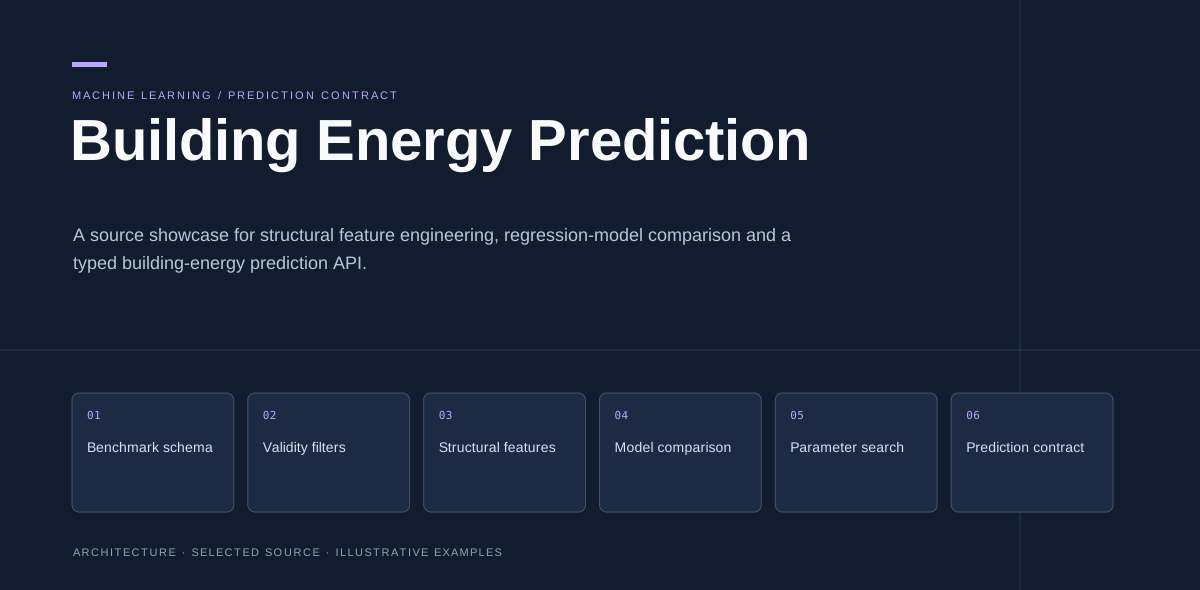
Illustrative architecture from the project presentation. It describes the selected design; it does not imply a deployed service or a measured operational result.
View the full-size diagramBenchmark schema
Validity filters
Structural features
Model comparison
Parameter search
Prediction contract
04 / Selected artifacts
source/model_workflow.pymodel_exploration.ipynbservice.pyfeatures_config.json05 / Scope & limitations
Demonstration and source showcase without reference data, trained models, model stores or a hosted service. The target is weather-normalized site energy use in kBtu. Cross-validation and parameter search are source examples without verified scores. Complete-case selection may bias the sample; a separate holdout, uncertainty assessment and drift checks are needed before relying on predictions. The API expects pre-engineered features and a separately registered model.
The GitHub repository is private. Its link works for authorized collaborators; other visitors can contact me to discuss the project.
Next case study / 07
The next conversation